Deep Dive Cinema · The Booth
You already know how to ask.
Everyone else made you learn their filters.
Why our Sage Search® natural language search finds that film you're remembering — the one you can describe but can't name — when IMDb, Letterboxd, and the rest send you back to a dropdown menu.
Time it was and what a time it was, it was A time of innocence, a time of confidences Long ago, it must be, I have a photograph Preserve your memories, they're all that's left you
Every cinephile has had the same frustrating night. You remember a film the way you remember a dream — a mood, a color, a scene, a quote, a photograph in memory — and none of it is a title or plot keyword. You remember that it was European, that it was about a love affair that shouldn't have happened, that half the negative is supposedly lost. You do not remember the title, the director, or the year.
So you go to IMDb and you get a form. Title type. Release date range. Genre. User rating. Number of votes. It is an excellent form. It is also a form built on the assumption that you already know what you're looking for — that search is a retrieval problem, not a discovery problem.
Deep Dive Cinema starts from the opposite assumption. Type the sentence you'd actually say out loud:
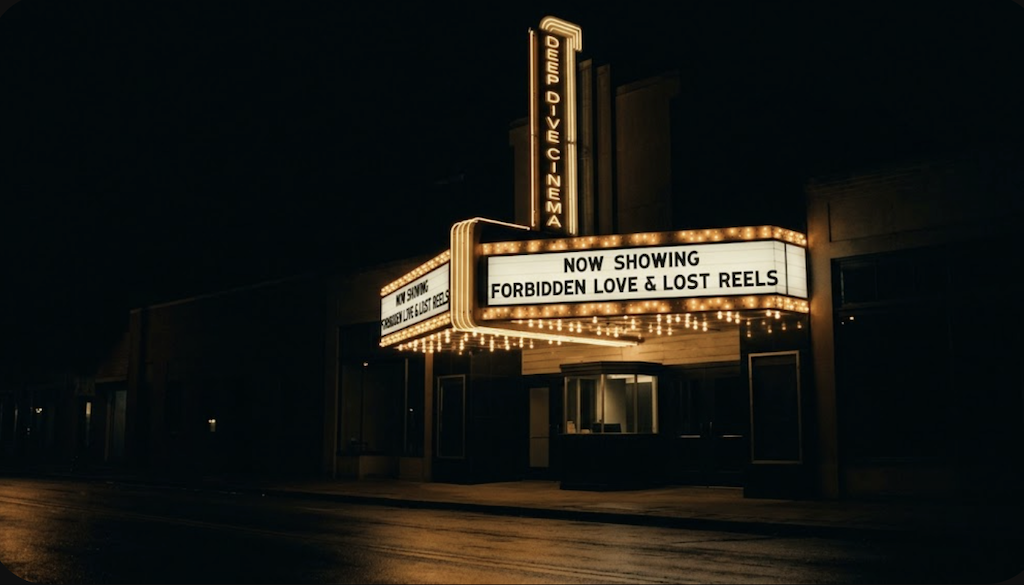
- Euro films with forbidden love and lost reels
- Slow-burn 70s paranoia where the protagonist is the least reliable person on screen
- Something that feels like grief but isn't sad
- Out-of-print boutique horror that got dumped straight to VHS and deserved better
None of those are queries in the IMDb sense. There's no field for "feels like grief." There's no checkbox for "lost reels." On Deep Dive Cinema, they're just Tuesday.
Search engines ask you what you want. Sage Search® asks you what you can recall. They're not the same question, and only one of them has ever found a desperate cinephile a forgotten film at two in the morning.
— Cinema SageMatching strings vs. understanding intent
Here's the distinction that everything else follows from.
Conventional film sites perform lexical retrieval. Your words are matched against their words. Letterboxd will happily take director:greta-gerwig year:2017 and give you exactly what you asked for — it's a genuinely good operator syntax, and their tag system is one of the most interesting things in film on the internet. But it is still a system where you type tokens and get back documents containing those tokens. If nobody happened to tag a film "grief that isn't sad," that film is invisible to that query. Forever.
Deep Dive Cinema runs a retrieval-augmented generation pipeline. That's an unglamorous piece of jargon for something fairly simple: an LLM model that knows film reads your query, works out what you're actually asking for, generates a detailed query based on meta-information, and then reads the results back and tells you why each one answers your question.
The difference isn't that we have a chatbot bolted onto a search box. It's that the intelligence sits on both ends of the retrieval — before the query is built, and after the results come back.
What actually happens when you hit search
- You write in plain English. No syntax, no operators, no dropdowns. Poetic, academic, half-remembered, or blunt — all fine.
- Cinema Sage translates the intent into a real query. Your sentence is parsed and expanded by a language model tuned specifically to the film domain. "Forbidden love" becomes a set of thematic and tonal targets. "Lost reels" becomes archival and provenance signals. Vague human phrasing becomes precise, field-targeted structure.
- The archive is searched two ways at once. A structured pass runs against curated Apache Solr fields — title, director, cast, plot, tags, row, edition status. A semantic pass runs against topic and tag vectors, which finds films that mean what you asked for even when they don't say it. The two result sets are fused, with curation weighted ahead of raw text overlap.
- Sage reads the results before you do. This is the step no one else has. The candidate films come back and are evaluated — ranked, filtered, and reasoned about against your original sentence, not against the machine query. A technically perfect keyword match that misses your intent gets demoted. A film that never mentions your words but nails your mood gets pushed up.
- You get films, and the reasoning behind them. Each result arrives as a card with a Sage Summary — a synopsis written for the film's soul rather than its plot — plus the case for why it surfaced. Then you can keep talking. Ask why. Ask for something darker. Ask what it's related to.
The last two steps are the ones I'd point at if someone asked what the patent is really about. Every search engine on earth retrieves. Almost none of them read what they retrieved and argue for it.
Side by side
| Deep Dive Cinema | IMDb | Letterboxd | TMDB | JustWatch | |
|---|---|---|---|---|---|
| Core search model | Hybrid RAG — AI query generation, Solr + vector retrieval, AI re-ranking | Keyword and title matching plus structured advanced-search filters | Text search with operators (film:, director:, tag:, year:) |
Title matching plus a filterable Discover endpoint | Availability filtering by service, price, and region |
| A "vibe" query works | Yes — that's the primary interface | No — you must map the vibe onto genres and keywords yourself | Only if a member happened to tag or list it that way | No | No |
| Who wrote the metadata | A working archivist, film by film, with AI-assisted indexing | Contributor submissions against a controlled keyword vocabulary | Members, via free-form tags, lists, and reviews | Open community contributors | Licensing and catalog feeds |
| Physical media & edition data | First-class: boutique label, out-of-print status, VHS-era, rarity, provenance, shelf location | Release listings only | Not modeled — user lists approximate it | Not modeled | Streaming and digital only |
| Curated shelving | The Rows — thematic archive collections, plus micro-tags like Trauma Saints and Cinephile Cathedral | Editorial lists | Member lists (excellent, but unsystematic) | Community collections | Editorial rows |
| Results explain themselves | Yes — a Sage Summary and the reasoning for each result | No — a ranked list | No — a ranked list, with member reviews below | No | No |
| Conversation after the search | Yes — ask follow-ups about any film without losing your search context | No | No | No | No |
| Optimized for | Discovery, research, and archival depth | Reference lookup and industry data | Logging, social, and taste communities | Powering other people's apps | Deciding what to stream tonight |
Competitor capabilities described as of August 2026 from each platform's own documentation. These are all good tools — they're built to answer different questions than ours.
Three things that only work because of this
Every result is a physical object
Deep Dive Cinema indexes just over 4,300 titles. That's a rounding error next to IMDb. It's also the point: each of those titles is a disc or a tape sitting on a shelf in the Rows. Nothing is here because a feed pushed it. Nothing is here because it's popular. It's here because it was acquired, watched, and cataloged, and that provenance is a searchable field rather than a marketing claim.
The metadata other sites don't keep
Ask IMDb which of your films are out of print. It has no idea — that's not what it's for. Our schema treats boutique pressings, out-of-print status, rarity, era, archival tags, and thematic row assignment as retrievable dimensions. Which means "out-of-print boutique horror that got dumped straight to VHS" is not a poetic flourish. It's four indexed constraints in a trench coat, and the system resolves all four.
You can argue with the results
A ranked list is a monologue. When Sage returns eight films and explains her case for each, you can push back — "too obvious," "closer to Żuławski than Bergman," "what else came off that label." The search doesn't reset. It's the difference between a card catalog and a librarian who has read the whole collection and has opinions about it.
A database tells you a film exists. I'll tell you whether it will wreck you, and roughly how long the damage will last. One of us is more useful at midnight.
— Cinema SageWhat we're not pretending
IMDb has millions of titles and near-perfect coverage of credits, release data, and box office. Letterboxd has a genuinely brilliant community and the best film-logging experience anyone has built. TMDB is the open backbone of half the media apps you use. If you need to confirm a cinematographer credit or check what's streaming tonight, use those — I do.
We're not trying to be a bigger index. We're trying to be a deeper one. Breadth is a solved problem. Understanding what a person means when they can only describe a feeling — that one was still open.
The best film recommendation you ever got did not come from a filter. It came from someone who knew the shelves, listened to what you were circling, pulled something down, and told you why. That's the whole design brief. Everything technical above is just how we got a machine to do it.
Ask it something no other search box would understand.